Custom Iron Work for Residential & Commercial Projects.

Common Iron Fence Problems in Las Vegas and How They Are Repaired
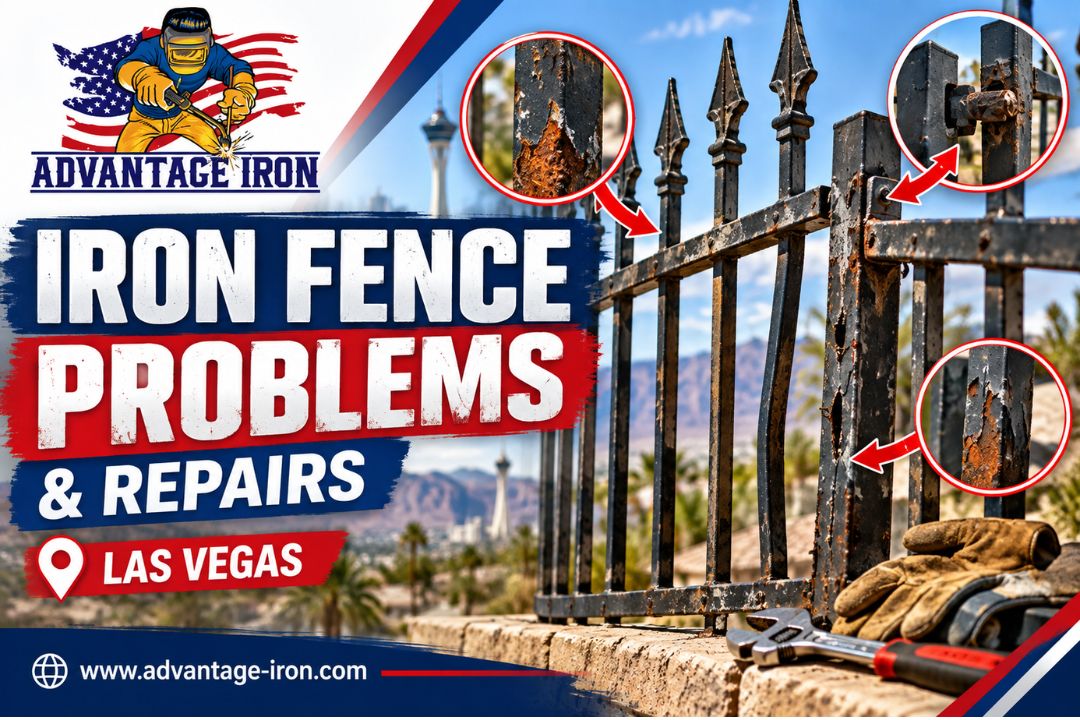
Quick Summary:- Common Las Vegas iron fence problems include surface rust, peeling finishes, cracked welds, leaning posts, bent panels, loose pickets, and gate misalignment. Most localized damage can be repaired through cleaning, welding, reinforcement, realignment, and refinishing. Replacement is usually necessary only when corrosion or structural damage is widespread.
Iron fencing is durable, but it is not indestructible. Las Vegas fences are continuously exposed to intense sunlight, high summer temperatures, blowing dust, strong winds, irrigation overspray, and occasional monsoon storms. The National Weather Service notes that Las Vegas regularly experiences triple-digit summer temperatures, gusty winds, blowing dust, and seasonal thunderstorms.
Fortunately, most isolated fence problems can be repaired without replacing the entire system. Professional iron fence repair may involve rust removal, welding, post reinforcement, panel straightening, hardware replacement, and refinishing.
Common Iron Fence Problems and Repairs
Fence Problem | Common Cause | Typical Repair |
Surface rust | Coating damage and moisture | Remove rust, prime and refinish |
Peeling coating | UV exposure or poor preparation | Strip loose finish and recoat |
Cracked weld | Stress, impact or poor original weld | Remove crack and reweld |
Leaning post | Weak footing or soil movement | Reset or replace post and footing |
Bent panel | Vehicle or equipment impact | Straighten, reinforce or replace section |
Loose pickets | Broken welds or fasteners | Reattach and refinish |
Gate misalignment | Worn hinges or moving posts | Realign and repair supports |
1. Rust and Corrosion
Rust develops when exposed iron or steel encounters oxygen and moisture. Las Vegas is dry, but fencing can still receive regular moisture from sprinklers, swimming pools, pressure washing, monsoon rain, and water trapped around posts.
Early signs include:
- Orange staining
- Rough surface spots
- Bubbling paint
- Rust around welds
- Corrosion near the ground
- Flaking metal
Professional rusted iron fence repair begins by removing loose coating and corrosion. The contractor then evaluates how much sound metal remains.
Minor corrosion may require surface preparation, rust-inhibiting primer, and exterior metal coating. If rust has created holes or weakened a rail, the affected metal may need to be cut out and replaced.
Protective coatings are the primary barrier preventing structural steel from contacting corrosive conditions, but their success depends heavily on surface preparation and application quality.
2. Peeling, Fading, or Chalking Finish
A fence can remain structurally sound while its finish deteriorates.
Common causes include:
- Years of UV exposure
- Inadequate surface preparation
- Incorrect coating selection
- Moisture beneath the finish
- Impact damage
- Previous paint applied over rust
Loose coating should be removed rather than painted over. The exposed surface must be cleaned, repaired, prepared, primed where required, and refinished.
Exterior powder coating can provide strong resistance to corrosion, UV exposure, and physical wear. However, the Powder Coating Institute notes that outdoor weatherability depends on the coating chemistry and that surface cleanliness and pretreatment strongly affect adhesion.
Can a Powder-Coated Fence Be Touched Up?
Small chips can often be protected with a compatible field-applied touch-up coating. A true full powder coating iron fence restoration generally requires removing the panels, stripping the old finish, preparing the metal, applying new powder, and curing it in an oven.
Simply brushing paint over damaged powder coating may hide the defect without properly stopping corrosion underneath.
3. Cracked or Broken Welds
Cracks often appear where pickets meet rails, panels attach to posts, or gates connect to hinges.
Possible causes include:
- Vehicle impact
- Repeated vibration
- Fence movement
- Poor original welds
- Stress from a sagging gate
- Corrosion around the joint
Professional fence welding repair should address both the crack and its underlying cause. The damaged weld is normally removed, the metal is cleaned and realigned, and the connection is rewelded and refinished.
The American Welding Society identifies cracks as serious discontinuities because their sharp ends concentrate stress and can allow the fracture to spread. Welding directly over an existing crack without completely removing it is not a proper repair.
4. Leaning or Loose Fence Posts
A fence panel may look damaged when the actual problem is below ground.
Posts can move because of:
- Inadequate concrete footings
- Soil movement
- Water collecting near the base
- Vehicle impact
- Excessive wind loading
- Corrosion at ground level
The repair may involve excavating around the post, removing failed concrete, resetting or replacing the post, and installing a properly sized footing.
Attaching the panel to a leaning post without correcting the foundation is a temporary patch. The fence will continue shifting and may damage additional rails or welds.
5. Bent Rails, Pickets, or Panels
Iron fences are often damaged by vehicles, landscaping equipment, falling objects, or attempted forced entry.
Minor bends may be straightened when the metal has not cracked or become severely distorted. More substantial damage may require cutting out and replacing the affected rail, picket, or panel.
A professional metal fence repair should restore:
- Proper panel alignment
- Consistent picket spacing
- Secure welded connections
- Original decorative details
- A continuous protective finish
Replacing only the damaged section is usually more economical than replacing an otherwise sound fence.
6. Loose or Missing Decorative Components
Finials, scrolls, rings, collars, medallions, and ornamental pickets can loosen over time or break after impact.
A decorative iron fence repair may involve recreating missing pieces, rewelding existing components, correcting alignment, and blending the finish with the surrounding fence.
For visible front-yard fencing, the replacement piece should match the existing scale and pattern. A structurally strong but badly mismatched repair can still reduce curb appeal.
7. Gate and Fence Misalignment
Fence problems frequently affect an attached gate. A moving post can cause the gate to drag, bind, or stop aligning with its latch.
Repairs may include:
- Resetting the gate post
- Replacing hinges
- Reinforcing mounting plates
- Rewelding damaged connections
- Adjusting the latch
- Realigning the gate frame
A gate operator should not be used to force a dragging gate open. The structural problem must be corrected before the motor or access-control equipment is serviced.
Should the Fence Be Repaired or Replaced?
Repair is generally sensible when:
- Rust is localized
- Only one panel is damaged
- Posts can be reset
- Cracks affect a limited number of welds
- Most of the original metal remains structurally sound
- Replacement pieces can match the existing design
Replacement may be better when:
- Corrosion has caused widespread metal loss
- Multiple posts and footings are failing
- Numerous welds repeatedly crack
- Most panels are severely bent
- The fence no longer meets security or property needs
- Repairing individual sections would approach replacement cost
Expert Maintenance Tips
Inspect your fence every few months, particularly around welds, bottom rails, posts, and areas reached by sprinklers.
Redirect irrigation away from the metal, clean off dirt and mineral deposits, and repair coating chips before corrosion spreads. After strong winds, storms, or vehicle impact, check posts and panels for movement.
Good wrought iron fence maintenance is mostly about catching small problems before they become structural ones.
Common Iron Fence Repair Mistakes
Painting Over Rust
New paint does not restore metal that has already lost structural thickness.
Welding Over an Existing Crack
The crack must be removed and the underlying stress or alignment problem corrected.
Repairing the Panel but Ignoring the Post
A fence attached to a moving post will fail again.
Using Epoxy for Structural Damage
Epoxy may be suitable for minor cosmetic filling, but it is not a substitute for a correctly welded structural connection.
Replacing More Than Necessary
A competent fabricator should explain which panels and posts can be retained before recommending complete replacement.
Schedule Iron Fence Repair in Las Vegas
Rust, cracked welds, leaning posts, bent panels, and damaged finishes usually become more expensive when ignored.
Advantage Iron provides welding, restoration, refinishing, custom fabrication, fence repair in Las Vegas, and new iron fence installation in Las Vegas for residential and commercial properties.
Contact Advantage Iron to schedule an inspection and determine which parts of your fence can be repaired, reinforced, or replaced.
Frequently Asked Questions
Yes, when enough sound metal remains. Surface corrosion can usually be cleaned and refinished, while severely weakened sections must be cut out and replaced.
Minor bends often can be corrected. Cracked, sharply folded, or badly distorted components may need replacement.
The damaged weld is removed, the surrounding metal is prepared and realigned, and the joint is rewelded before the protective finish is restored.
A properly applied exterior powder coating provides a durable finish, but both systems depend on correct preparation. Powder coating is not maintenance-free.
Replacement is usually appropriate when corrosion, post failure, or physical damage affects a large portion of the fence and localized repairs would not provide a reliable result.