Custom Iron Work for Residential & Commercial Projects.

What Are the Design Options for Wrought Iron Gates?
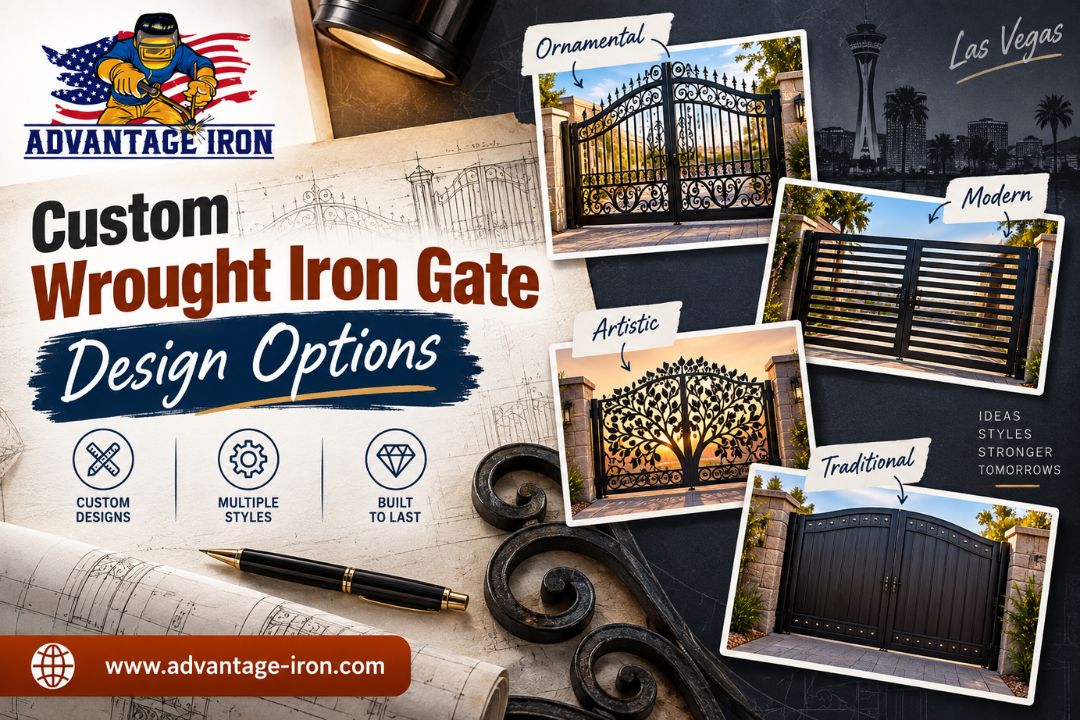
Quick Summary:- Custom wrought iron gates can be traditional, modern, ornamental, private, open, arched, straight, sliding, swinging, manual, or automatic. Buyers can customize the frame, pickets, panels, scrollwork, finish, opening system, access controls, and matching fencing. The best design balances architecture, security, privacy, driveway space, and daily use.
The main design options for custom wrought iron gates include traditional scrollwork, modern geometric patterns, arched or straight tops, privacy panels, decorative cutouts, mixed-material infill, swing or sliding operation, and automatic access controls.
A custom gate should not be selected from appearance alone. Its design must also suit the opening width, driveway slope, available operating space, desired security, privacy needs, property architecture, and frequency of use.
Wrought Iron Gate Design Options at a Glance
Gate Design | Defining Features | Best Application |
Traditional ornamental | Scrolls, finials, arches and medallions | Mediterranean and luxury homes |
Modern geometric | Straight lines, grids and clean spacing | Contemporary properties |
Full-privacy | Solid metal or screened infill | Private driveways and backyards |
Semi-private | Open upper section with solid lower panels | Privacy with some visibility |
Arched-top | Curved upper frame | Estate and traditional entrances |
Straight-top | Clean horizontal upper frame | Modern and minimalist homes |
Double swing | Two leaves opening inward or outward | Wide residential driveways |
Sliding | Moves parallel to the fence line | Sloped or space-restricted entrances |
Automatic | Motorized with access controls | Frequently used driveways |
Personalized | Initials, logos or custom artwork | Signature residential or commercial entrances |
1. Traditional Ornamental Iron Gates
Traditional ornamental iron gates use details such as:
- Scrollwork
- Twisted pickets
- Spears and finials
- Floral motifs
- Decorative rings
- Medallions
- Curved rails
- Hammered metal textures
This style works particularly well with Mediterranean, Spanish, Tuscan, Southwestern, and estate-style architecture.
The level of decoration can range from restrained scrolls around the center of the gate to elaborate metalwork covering the entire entrance. Competitor collections demonstrate that ornamental gates can combine arches, curls, circles, leaves, birds, and contrasting decorative finishes.
Too much ornamentation can make a smaller entrance feel crowded. The design should remain proportional to the driveway, columns, home, and surrounding fence.
2. Modern and Contemporary Iron Gates
Modern wrought iron gates usually rely on clean lines rather than decorative scrollwork.
Common contemporary designs include:
- Horizontal metal slats
- Vertical bars
- Rectangular grids
- Asymmetrical patterns
- Wide perimeter frames
- Laser- or waterjet-cut panels
- Minimal visible hardware
- Matte black or neutral finishes
Straight-top gates generally fit modern architecture better than highly arched or heavily decorated designs. Geometric layouts can also be repeated in balcony railings, courtyard gates, security doors, and fencing to create a consistent exterior.
AR Iron identifies minimalist, ornamental, and fully customized designs as distinct options, including gates with geometric bars, artwork, initials, and scene-based cutouts.
3. Arched-Top and Straight-Top Gates
The top profile strongly influences how a gate looks from the street.
Arched-Top Gates
An arched gate creates a formal, traditional appearance. Options include:
- Gentle continuous arches
- High center arches
- Reverse arches
- Separate arches over each gate leaf
- Arches with finials or scrollwork
Arched gates often complement homes that already use curved windows, entry doors, porticos, or masonry openings.
Straight-Top Gates
A straight-top gate feels cleaner and more contemporary. It works well with flat rooflines, rectangular architecture, modern landscaping, and minimalist fencing.
A straight top can still include decorative pickets, circles, panels, or security finials without becoming overly traditional.
4. Open, Semi-Private, and Full-Privacy Designs
Open Iron Gates
Open pickets preserve visibility and airflow. They allow occupants and cameras to see approaching visitors while reducing the amount of wind pressure placed on the gate.
Semi-Private Gates
Semi-private gates might use solid lower panels with open pickets above. This can conceal pets, vehicles, or yard areas while maintaining some outward visibility.
Full-Privacy Gates
Full-privacy designs use:
- Solid steel panels
- Perforated metal
- Decorative screens
- Closely spaced slats
- Wood or composite infill
- Metal backing behind ornamental work
Closed-metal and wood-and-iron configurations are established ways to add privacy without abandoning ornamental detailing.
Solid gates catch more wind than open picket gates. Their posts, hinges, frame, footings, and automatic operator must therefore be designed for the finished gate not selected as an afterthought.
5. Single and Double Driveway Gates
Single Swing Gates
A single gate leaf creates a clean appearance but becomes heavy as the driveway opening grows. It also needs substantial space to complete its opening arc.
Double Swing Gates
Double driveway iron gates split the opening into two leaves. This reduces the length and weight carried by each hinge assembly and creates a balanced estate-style entrance.
Double gates are commonly paired with masonry columns, lighting, decorative crests, or matching pedestrian entrances.
A gallery can show useful proportions, but every driveway should be measured individually. Custom gate manufacturers commonly alter gate dimensions and styling to fit the actual opening.
6. Sliding and Cantilever Gate Designs
Sliding gates move parallel to the fence or wall rather than swinging across the driveway.
They are useful when:
- The driveway slopes upward
- Vehicles cannot wait within a swing arc
- Landscaping limits inward movement
- The entrance needs a wide clear opening
A tracked gate rolls along a ground track. A cantilever gate is suspended above the driveway and requires additional space beside the entrance for its extended frame.
The operating system affects the visible design. Sliding gates often suit contemporary horizontal or geometric patterns, while double swing gates naturally support traditional symmetrical designs.
7. Automatic Wrought Iron Gates
Automatic wrought iron gates can preserve nearly any visual style while adding controlled access.
Automation options include:
- Remote controls
- Keypads
- Intercoms
- Smartphone entry
- Vehicle detectors
- Card or credential readers
- Cameras
- Battery backup
- Safety sensors
The operator should be chosen after the gate’s width, weight, wind exposure, and expected daily use are established. Decorative panels and privacy infill can significantly increase the load placed on the motor and supporting hardware.
8. Personalized and Luxury Iron Gates
Luxury iron gates can be customized with details that make the entrance specific to the property.
Options include:
- Family initials
- Business logos
- Custom emblems
- Desert landscapes
- Geometric artwork
- Animals or botanical patterns
- Address numbers
- Contrasting metal accents
- Custom post caps
- Integrated lighting
Personalization should remain readable and proportional. A simple central medallion often looks more refined than filling every available space with decoration.
9. Finishes and Color Options
Black remains popular because it works with most architectural styles, but it is not the only choice.
Possible finishes include:
- Matte black
- Satin black
- Dark bronze
- Charcoal
- Brown
- White
- Textured finishes
- Antiqued or distressed effects
- Contrasting finials and medallions
The finish should coordinate with the home’s doors, windows, railings, lighting, fencing, and exterior hardware.
Common Gate Design Mistakes
Choosing a Design Without Measuring the Site
A design may look excellent in a gallery but fail when applied to a sloped driveway, narrow side yard, or restricted opening.
Prioritizing Decoration Over Structure
Scrollwork cannot compensate for an undersized frame, inadequate posts, weak hinges, or poor welding.
Adding Privacy Panels After Fabrication
Privacy infill changes the gate’s weight and wind exposure. It should be included in the original structural design.
Forgetting the Pedestrian Entrance
A matching pedestrian gate can prevent people from using an automatic vehicle gate as a walkway.
Copying the Home Too Literally
The gate should complement the architecture rather than reproduce every curve, color, and decorative detail.
Expert Tip: Bring Reference Photos and Priorities
When requesting iron gate installation in Las Vegas, provide two or three reference images and explain what you like about each one.
Also identify your priorities:
- Security
- Privacy
- Architectural appearance
- Automation
- Pet containment
- Budget
This gives the fabricator clearer direction than simply asking for a “modern” or “ornamental” gate.
Design a Custom Wrought Iron Gate for Your Property
The best gate design balances appearance with security, privacy, movement, structural support, and daily convenience.
Advantage Iron designs, fabricates, and installs ornamental, modern, privacy, driveway, pedestrian, sliding, swing, and automatic iron gates throughout Las Vegas.
Contact Advantage Iron to discuss your preferred style and receive a custom gate design created for your property’s exact opening and architecture.
Frequently Asked Questions
Traditional arched gates and modern straight-top geometric gates are both widely used. The right option depends on the home’s architecture rather than one universally popular style.
Yes. Solid metal, perforated panels, privacy mesh, wood infill, or closely spaced slats can be added to the iron frame.
Yes, provided the frame, hinges, posts, operator, safety equipment, and electrical system are designed for the completed gate.
Swing gates suit level driveways with enough opening space. Sliding gates are often better for sloped driveways or entrances with restricted swing clearance.
Yes. A custom fabricator can repeat picket spacing, rails, finials, scrollwork, colors, and post details from an existing ornamental iron fence in Las Vegas.