Custom Iron Work for Residential & Commercial Projects.
Wrought Iron vs. Steel vs. Aluminum Gates for Las Vegas Homes
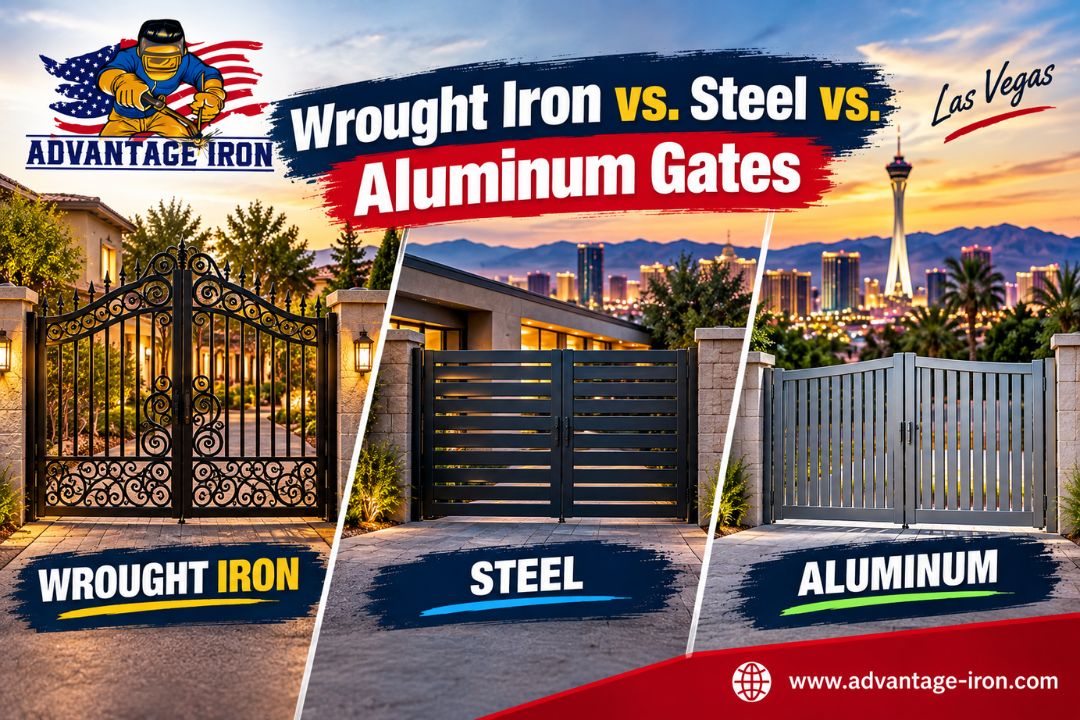
Quick Summary:- Wrought iron offers traditional craftsmanship and ornamental detail, steel delivers the strongest balance of security and customization, and aluminum provides lightweight, corrosion-resistant performance. For most Las Vegas homes, professionally fabricated and powder-coated steel is the practical all-around choice, while aluminum suits lower-maintenance residential and automatic gate projects.Choosing between wrought iron gates, steel gates, and aluminum gates requires more than comparing appearance. The right material depends on the gate’s size, security purpose, design, automation system, maintenance requirements, and supporting structure.
For most Las Vegas properties, custom-fabricated steel provides the strongest balance of security, design flexibility, repairability, and cost. Aluminum is a sensible option when lower weight and reduced corrosion maintenance matter more than maximum impact resistance. Genuine wrought iron offers unmatched traditional character but is less commonly used in modern gate fabrication.
Wrought Iron vs. Steel vs. Aluminum: Quick Comparison
Feature | Wrought Iron | Steel | Aluminum |
Security | Excellent | Excellent | Moderate |
Weight | Very heavy | Heavy | Lightweight |
Customization | Excellent for traditional details | Excellent for traditional or modern designs | Good |
Rust risk | Requires protection | Requires protection | Does not develop iron rust |
Maintenance | Moderate to high | Moderate | Low |
Impact resistance | High | High | Lower |
Automation | Requires heavy-duty equipment | Requires properly rated equipment | Easier on operators |
Typical positioning | Premium specialty option | Best all-around choice | Low-maintenance option |
The material alone does not determine quality. Frame thickness, internal bracing, weld quality, posts, hinges, footings, finish, and installation can matter more than whether the gate is labeled iron, steel, or aluminum.
Important Clarification: Are Modern Wrought Iron Gates Really Wrought Iron?
Many products advertised as wrought iron driveway gates are actually fabricated from mild steel and designed in a traditional wrought iron style.
Genuine wrought iron is a low-carbon, fibrous material shaped through forging. The National Park Service notes that mild steel is now widely used to fabricate new hand-worked metalwork and repair historic wrought iron because it is strong and workable.
This does not mean a modern “wrought iron” gate is inferior. It means buyers should ask what material and tubing thickness will actually be used rather than relying on a marketing label.
Wrought Iron Gates: Best for Traditional Character
Genuine wrought iron is associated with handcrafted scrolls, finials, curves, leaves, and decorative estate-style designs. It works especially well for historic architecture, luxury entrances, courtyards, and ornamental focal points.
Advantages of Wrought Iron
- Traditional, handcrafted appearance
- Strong and difficult to bend
- Highly repairable by experienced metalworkers
- Suitable for elaborate decorative details
- Can remain functional for decades with proper care
Disadvantages of Wrought Iron
- More expensive and less commonly available
- Heavy, requiring substantial posts and hinges
- Requires coating and corrosion maintenance
- May require a powerful operator when automated
- Not necessary for homeowners who only want the visual style
Best for: Luxury homeowners seeking authentic craftsmanship or historically appropriate ornamental iron gates.
Steel Driveway Gates: Best Overall for Las Vegas Homes
Steel is the most practical material for many custom residential and commercial gates. It can be fabricated into ornate traditional gates, modern geometric designs, privacy gates, security entrances, or automated driveway systems.
Steel is an iron-and-carbon alloy that combines strength with workable fabrication characteristics.
Advantages of Steel Gates
- Strong enough for security-focused entrances
- Suitable for long driveway gate spans
- Easily welded, reinforced, modified, and repaired
- Supports privacy panels and access-control equipment
- Available in traditional and contemporary designs
- Usually more practical than genuine wrought iron
Disadvantages of Steel Gates
- Exposed steel can rust
- Heavy gates need appropriate posts and footings
- Poor alignment increases hinge and operator wear
- Damaged coating must be repaired promptly
- Large solid gates require proper wind-load planning
A professionally prepared powder-coated finish can improve resistance to corrosion, UV exposure, scratching, fading, and physical wear. However, powder coating performance still depends on surface preparation, coating selection, coverage, and curing.
Best for: Security, custom fabrication, luxury designs, commercial entrances, privacy gates, and most custom driveway gates in Las Vegas.
Aluminum Driveway Gates: Best for Low Maintenance
Aluminum is lightweight and naturally corrosion resistant. The Aluminum Association describes architectural 6xxx-series alloys as weldable, moderately strong, and highly corrosion resistant.
Unlike steel or iron, aluminum does not produce iron oxide rust. Its surface can oxidize, and its coating can still fade or become damaged, but it generally requires less corrosion-related maintenance.
Advantages of Aluminum Gates
- Much lighter than steel or wrought iron
- Places less load on hinges and operators
- Naturally corrosion resistant
- Suitable for large automated residential openings
- Requires fewer rust-related touch-ups
- Available in multiple powder-coated finishes
Disadvantages of Aluminum Gates
- Generally less resistant to impact or forced entry
- Can dent or bend more easily
- Thin residential-grade sections may feel less substantial
- Repairs can require specialized aluminum welding
- Large gates still need engineered reinforcement
Best for: Homeowners prioritizing low maintenance, lighter operation, decorative entrances, or automatic driveway gates without maximum-security requirements.
Which Material Performs Best in Las Vegas?
Best for Security: Steel
Steel’s strength, weight, and fabrication flexibility make it the strongest practical choice for residential security gates, commercial properties, and controlled-access entrances.
Best for Low Maintenance: Aluminum
Aluminum eliminates traditional iron-rust concerns and reduces weight on hinges and motors. It is especially useful when the gate will open frequently.
Best for Custom Designs: Steel or Wrought Iron
Both can support scrollwork, arches, decorative panels, monograms, finials, and architectural patterns. Steel usually achieves the desired appearance at a more practical cost.
Best for Automatic Gates: It Depends
Aluminum’s lower weight reduces the mechanical load on an operator. Steel provides greater rigidity and security but requires appropriately rated motors, hinges, posts, and footings.
The correct operator should be selected based on the completed gate’s weight, width, wind exposure, opening frequency, and movement—not the material name alone.
Practical Examples
Luxury Estate Entrance
A powder-coated ornamental steel gate provides the appearance of traditional wrought iron while supporting custom scrollwork, masonry columns, lighting, and access controls.
Frequently Used HOA Gate
Steel may provide better impact resistance for a high-traffic entrance, but the frame, operator, safety equipment, and maintenance schedule must be designed for frequent cycles.
Residential Gate with Minimal Upkeep
An aluminum gate may be the better fit for a homeowner who values easy operation and does not require a heavy security barrier.
Full-Privacy Driveway Gate
Steel usually provides the rigidity needed for privacy panels. However, solid surfaces increase wind pressure, so posts, footings, hinges, and operators must be engineered accordingly.
Common Gate Material Selection Mistakes
Buying Based Only on Appearance
Aluminum, steel, and wrought iron-style gates can look similar after finishing. Their weight, strength, hardware requirements, and repair options are different.
Assuming Heavier Always Means Better
A heavy gate can create premature hinge, post, and motor problems when the supporting system is inadequate.
Ignoring Material Thickness
A properly reinforced aluminum gate may outperform a poorly constructed thin-steel gate. Request specifications for the frame, pickets, bracing, posts, and hinges.
Choosing the Operator Before Designing the Gate
The completed gate should determine the operator—not the other way around.
Treating Powder Coating as Maintenance-Free
Inspect coating chips, welds, hinges, bottom rails, and areas exposed to irrigation. No exterior finish is completely maintenance-free.
Expert Tip: Compare Complete Gate Systems
When requesting estimates for driveway gates in Las Vegas, compare:
- Actual frame material and thickness
- Gate width, height, and weight
- Internal structural bracing
- Weld construction
- Posts and concrete footings
- Hinges, rollers, and hardware
- Surface preparation and finish
- Automation compatibility
- Installation and warranty coverage
A vague quote for a “wrought iron gate” does not provide enough information to judge quality.
Choose the Right Custom Gate for Your Property
For most Las Vegas homes, powder-coated steel provides the strongest combination of security, customization, appearance, and repairability. Aluminum is better for homeowners prioritizing low weight and low corrosion maintenance, while genuine wrought iron is best reserved for premium or historically inspired projects.
Advantage Iron designs, fabricates, and installs custom metal gates, ornamental gates, driveway gates, and residential security gates throughout Las Vegas.
Contact Advantage Iron to compare materials and receive a custom gate recommendation based on your property, security needs, design, and budget.
Frequently Asked Questions
Not automatically. Genuine wrought iron provides traditional craftsmanship, but fabricated steel is usually more accessible, cost-effective, and suitable for modern driveway gate systems.
Yes, when properly engineered. They are appropriate for many residential entrances but may not provide the same impact resistance as a heavy steel security gate.
They can. Las Vegas is dry, but sprinkler overspray, pool water, monsoon rain, coating damage, and trapped moisture can expose steel to corrosion.
Aluminum reduces operator load, while steel offers greater rigidity and security. The best option depends on gate size, usage, wind exposure, design, and access-control requirements.
Fabrication quality, coating, installation, and maintenance usually determine service life more reliably than the material category alone.